

Can academic projects explore new directions and contribute to public discourse on global and local issues? The 2025 Politecnico di Torino Architecture Students Award aimed to address these questions, showcasing how architectural research, training, and experimentation can be integrated into a school curriculum.
Politecnico di Torino is ranked among the top 20 architecture schools in Europe (QS World University Rankings by Subject 2025 - Architecture and Built Environment). With over 3,000 students, the Department of Architecture and Design offers a Bachelor's degree in Architecture and three Master's programs—Architecture for Sustainability, Architecture Construction City, and Architecture for Heritage—all featuring dedicated English tracks. The Department also offers two Bachelor's and one Master's programs in Design.
The project selection process featured insights from Mette Ramsgaard Thomsen (Royal Danish Academy and director of CITA - Centre for Information Technology and Architecture), Daniele Belleri (partner at CRA), Paolo Scoglio (The ne[s]t), Michele Bonino, and Silvia Gron. All awarded projects, along with a curated selection of works from the Department courses and studios, are available on the departmental platform Telearchitettura.
Georgian Darbazi: Inspecting the fibers of the past, present & future by Gvantsa Tskipurishvili
The subject of the thesis is the investigation, analysis and methodological proposals for the conservation of wooden vernacular architecture located in Meskheti, a historical region of Georgia. It includes historical research, analysis of technologies, materials and construction systems, in situ assessments for different housing case studies, analysis of main problems, possible solutions and consequent methodology for the conservation and/or reinforcement of such timber structures.


Exploring Socialist Modernism in Bulgaria: A Historical Analysis and Adaptive Reuse of the Bankya Residence as a Case Study of Dissonant Heritage Transformation by Iliyan Stoykov
Thе thesis develops a methodology for objectively analyzing and adapting Bulgaria's modernist architectural heritage, presenting the abandoned Bankya Residence as a case study. Focusing on contemporary debates about heritage preservation, the research highlights the architectural importance of unique architecture, distinct from typical Eastern Bloc residential design. It examines the socio-cultural context and presents an in-depth study of Bankya Residence, including original archives, professional photography, and detailed 3D models. A two-stage restoration strategy is proposed, encouraging careful integration into modern society without compromising historical authenticity. The thesis ultimately promotes professional, politically neutral approaches to preserving and adapting dissonant heritage sites.

Past Imaginaries: A scenario of spatial politics for an alternative present in post-earthquake Antakya by Ezgi Sahin
Antakya, one of the cities most affected by the earthquakes of February 6, 2023, and the changes it underwent after the earthquakes, form the basis of this research. The research aims to examine post-earthquake political processes from an architectural perspective by investigating the school building network in Antakya's city centre. Through this study, an alternative narrative is presented where architectural and political elements coexist. Furthermore, a specific school within the network is subjected to a detailed retrospective study in which the dynamics of architecture and politics are discussed.

("Hello, city"). Parametric tools for urban design by Melanie Nicole Giler Pinargote, Irene Zecchini
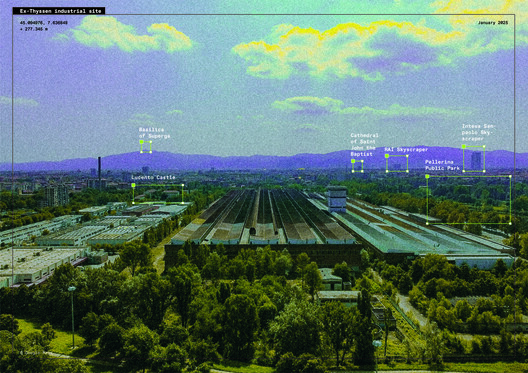
How do you design a city? The city is a living organism, constantly evolving, shaped by the interaction between data, constraints, and design ideas. In this context, the parametric approach and its computational tools allow the generation of a wide range of urban scenarios, created through spatial and temporal variations. These scenarios are not outcomes, but represent the entire process required to reach them. The process is applied to the former Thyssen area in Turin, in order to test the potential and limitations of algorithmic thinking in urban design. Within this academic research framework ("Hello, city"), like ("Hello, world") in computer programming, experiments with new tools and development environments are conducted.

Fynbos Futures. A Speculative Re-Imagining of the Cape Flats by Cara Geldenhuys
This thesis explores the entanglement of ecological degradation and urban inequality in Cape Town's Cape Flats, a marginalized territory home to the critically endangered plants, the Cape Flats Sand Fynbos. The work develops the methodology of Fiction-Friction, which combines situated research with fictional narrative to re-imagine post-apartheid urbanism. Central to the work is an original manuscript titled: Fynbos Futures, which acts as a design tool to imagine alternative futures for the Flats. By centering more-than-human agency and embracing alienation as a generative force, three future scenarios are developed: the contaminated, amphibious and temporal territories, with each scenario offering grounded, hopeful visions for just urban futures.

Honorable mention
The abandoned Ski Resorts. The architectural and landscape regeneration project of Monte Farno in Gandino by Alessandro Comina and Lorenzo Ciarfella
Decommissioned ski resorts are increasing in mountain areas, reflecting the failure of an outdated economic model based on winter tourism. Due to climate change and evolving social needs, this situation calls for a reconsideration of these sites as opportunities for sustainable and resilient tourism. The thesis analyses this phenomenon and introduces the A.D.I.R.A. project, aimed at mapping abandoned structures throughout the Italian Alpine Arc. The case study of Monte Farno highlights the urgent need for regenerative interventions, culminating in a proposal for the landscape and architectural revitalization of the case study.

Designing Asylum Space? Political Asylum Architecture, an incomplete understanding by Rossella Altobelli
The thesis begins by tracing how asylum emerged and re-emerged from antiquity to the end of the XX century, not as a linear history but as a series of conditions that allowed the spatialization of its practice. The focus then shifts to contemporary Italy, where asylum emerges through law and decrees. Laws are taken and analyzed semantically, with the textual operations transformed into spatial ones, allowing the evolution of reception infrastructure to emerge. The work concludes with a set of reflections on design, offering open-ended fragments that return to a central question: what makes asylum space?

Resilient Remains: A strategy for post-war collective housing in Kharkiv, Ukraine by Begüm Sera Savas
The adaptive reuse of Soviet-era panel buildings offers a resilient alternative to demolition in post-conflict Kharkiv, revealing both their structural durability and untapped social potential. It addresses both the urgent need for post-war housing and the long-term goals of urban and social regeneration. Through the development of the Abacus of Manipulations, the project offers a toolkit of spatial strategies addressing rigidity, fragmentation, and lack of communal space. Grounded in Kharkiv's recovery, the approach proposes a scalable model for transforming war-affected or aging housing into sustainable, community-oriented environments through circular use of existing housing stock.


